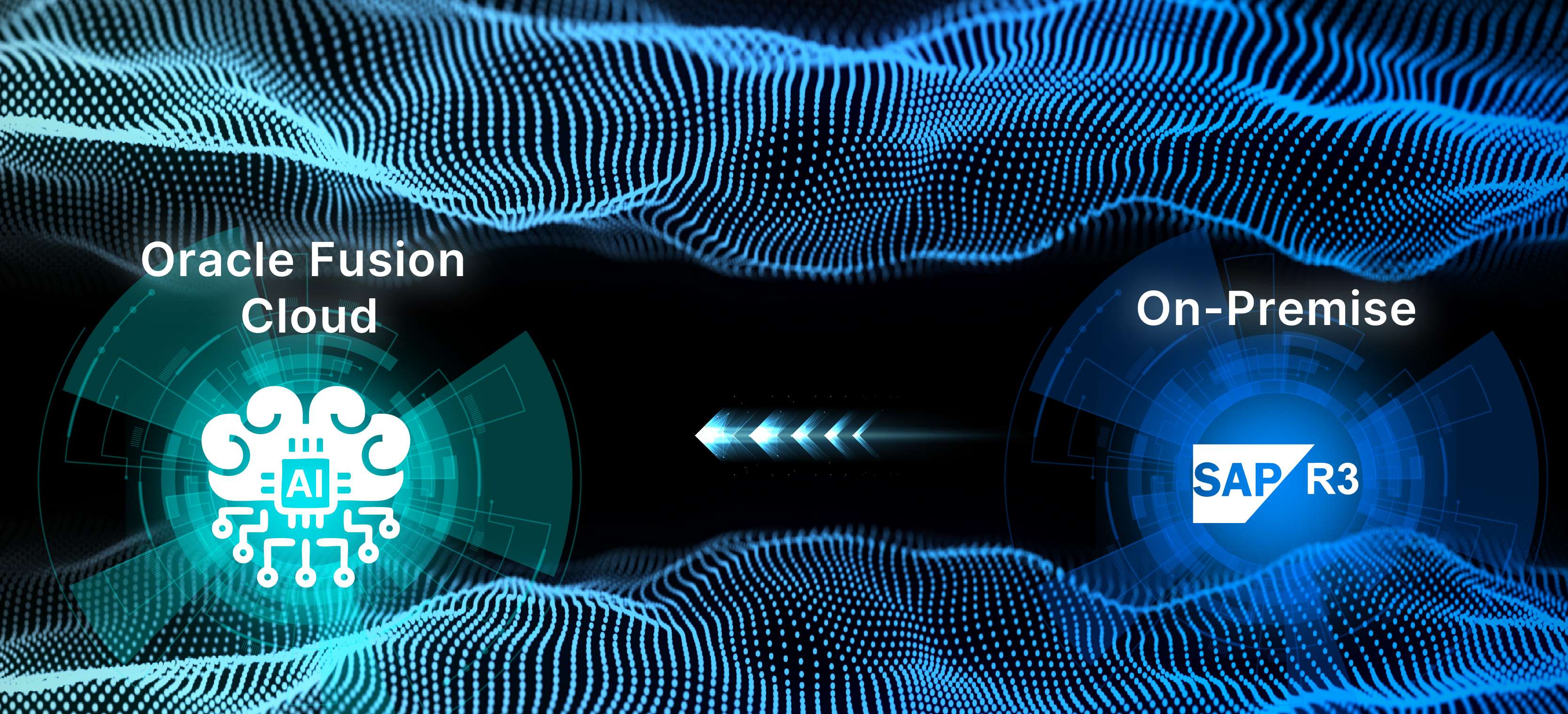
For over two decades, SAP R/3 supported enterprise operations through heavy on-premise infrastructure, custom ABAP code, and large BASIS teams. That model once delivered stability, but by 2025 its limits are clear—slow patch cycles, bolted-on mobility, and costly third-party integrations for analytics and AI. Each workaround adds complexity and risk, turning ERP from a backbone into a bottleneck.
Sustained progress requires a shift to cloud-native, intelligent data management—an approach ChainSys enables by rebuilding the data foundation and orchestrating a controlled transition to Oracle Fusion Cloud. This transformation replaces fragmented processes with unified, real-time data flows that support automation, embedded analytics, and AI-driven decision-making at scale.
Proven across 60+ global enterprises, including multi-petabyte migrations and the reconciliation of hundreds of millions of open transactions, the outcome is operational clarity: month-end close cycles reduced from days to hours and ERP repositioned as a growth platform rather than a cost center.
Picture this: a $2B manufacturer still running ECC 6.0 EHP7 on HANA because “R/3 works fine.” Their CFO needs a cash forecast at 4 PM on a Friday. The answer? Kick off a batch job at 6 PM, pray the variant runs clean, and hope the report lands by Monday. Meanwhile, a startup competitor using Oracle Fusion Cloud gets the same forecast on their phone in 45 seconds.
The math is brutal
But the real killer is agility. Every custom Z-table you built in 2003 is now technical debt. Every user exit is a regression risk. Every interface is a 2 AM pager.
We saw this firsthand with a retail chain in the Midwest.
When Oracle announced Fusion’s Autumn ’24 release with embedded machine learning for demand sensing, the client’s VP of Supply Chain asked a simple question: “How fast can we get there?” The answer: 11 months, zero production downtime, $1.8M saved in year one.
We don’t believe in “lift and shift.” We believe in transforming and thriving. At the core of this approach is dataZap, our no-code migration engine purpose-built for complex ERP transformations. Acting as a Swiss Army knife for enterprise data, dataZap extracts, profiles, cleans, maps, loads, and reconciles SAP data into Oracle Fusion Cloud at speeds of up to 50,000 records per second, with full end-to-end encryption and auditability.
For readers who want to dive deeper into the mechanics, architecture, and controls behind this engine, the full technical breakdown is available in the dataZap Documentation, covering everything from extraction logic to reconciliation and validation workflows.
This keeps the flow intact, signals technical depth, and lets you reference the documentation without turning the paragraph into a hyperlink callout.
Most consultancies start coding on day one. We start with forensics. dataZap crawls the SAP system catalog, ABAP dictionary, and transport logs to produce a 360-degree heatmap. Red flags pop for:
A manufacturing client discovered 312 unused InfoCubes consuming 180 GB. We archived them in week two, freeing 15% of their HANA footprint before migration even began.
SAP R/3 is forgiving. Oracle Fusion Cloud is not.
What SAP allowed to pass silently—duplicate vendors, inconsistent units of measure, free-text payment terms—becomes a hard failure in Fusion, multiplying downstream issues across procurement, payables, and reporting.
This phase is where migration success is decided.
Instead of relying on manual cleanups or spreadsheet-driven corrections, ChainSys executes data cleansing through its Smart Data Platform, with dataZen governing quality and compliance, and dataZap executing approved transformations at scale.
Weekends are sacred. That’s why we extract in parallel streams while SAP stays live. For a recent logistics client:
Here’s where the magic happens. dataZap contains 10,000+ pre-built mapping templates. Example: SAP’s MARC table becomes Fusion’s EGP_SYSTEM_ITEMS with plant-specific attributes auto-split into inventory orgs. Currency fields? We convert on-the-fly using ECB rates from the migration date.
But not everything maps 1:1. Consider SAP’s condition records (KONV) versus Fusion’s pricing algorithms. We collapse 40,000 condition lines into 400 pricing rules using clustering algorithms—reducing admin overhead by 90%. The logic is fully auditable; download the mapping spec as Excel with one click.
Fusion’s data model is stricter than SAP’s. We load in micro-batches of 50,000 records, validate immediately, and roll back only the failed batch. A financial services client loaded 42 million GL balances; 0.003% errored due to legacy cost elements. dataZap auto-created journal entries to bridge the gap—approved by controllers before go-live.
Post-load, we run 200+ reconciliation reports:
Discrepancies under $100 auto-post as adjustments; anything larger routes to a ticketing queue. The entire process is scripted—no manual Excel heroics.
Migration doesn’t happen in a vacuum. Your SAP R/3 instance talks to other systems—EDI, WMS, tax engines, and banks. We catalog every interface during discovery, then rebuild using Oracle Integration Cloud (OIC) adapters.
A consumer goods company had 22 VAN-based EDI partners. We migrated to Fusion’s B2B module in four weeks, cutting transmission costs 40%.
For real-time needs, we enable Fusion’s Event Hub. Example: shipment confirmation in Oracle Transportation Management triggers inventory relief in Fusion within 3 seconds—down from SAP’s 15-minute IDoc poll.
SAP R/3 workflow = user exits + endless ABAP. Fusion = low-code Process Automation. Take invoice approval:
We converted 180 such workflows for an energy client. Total effort: 11 person-weeks. Ongoing maintenance? Near zero.
The bigger win is Adaptive Intelligence. Fusion’s ML models learn from your data. One retailer now gets:
Migration is the perfect time to lock the barn door. We enforce:
A healthcare client needed HIPAA alignment. We masked PHI during extraction, tokenized it in flight, and rehydrated only in Fusion’s prod tenant.
The connector library is detailed on the Data Integration page, where ChainSys highlights "an extensive library of pre-built connectors for all major ERP, CRM, and other enterprise systems" to support real-time, secure integrations (including scenarios like EDI for consumer goods companies).
Dress rehearsals are mandatory. We run three mock cutovers, each shaving hours off the plan. Final timeline for a recent migration:
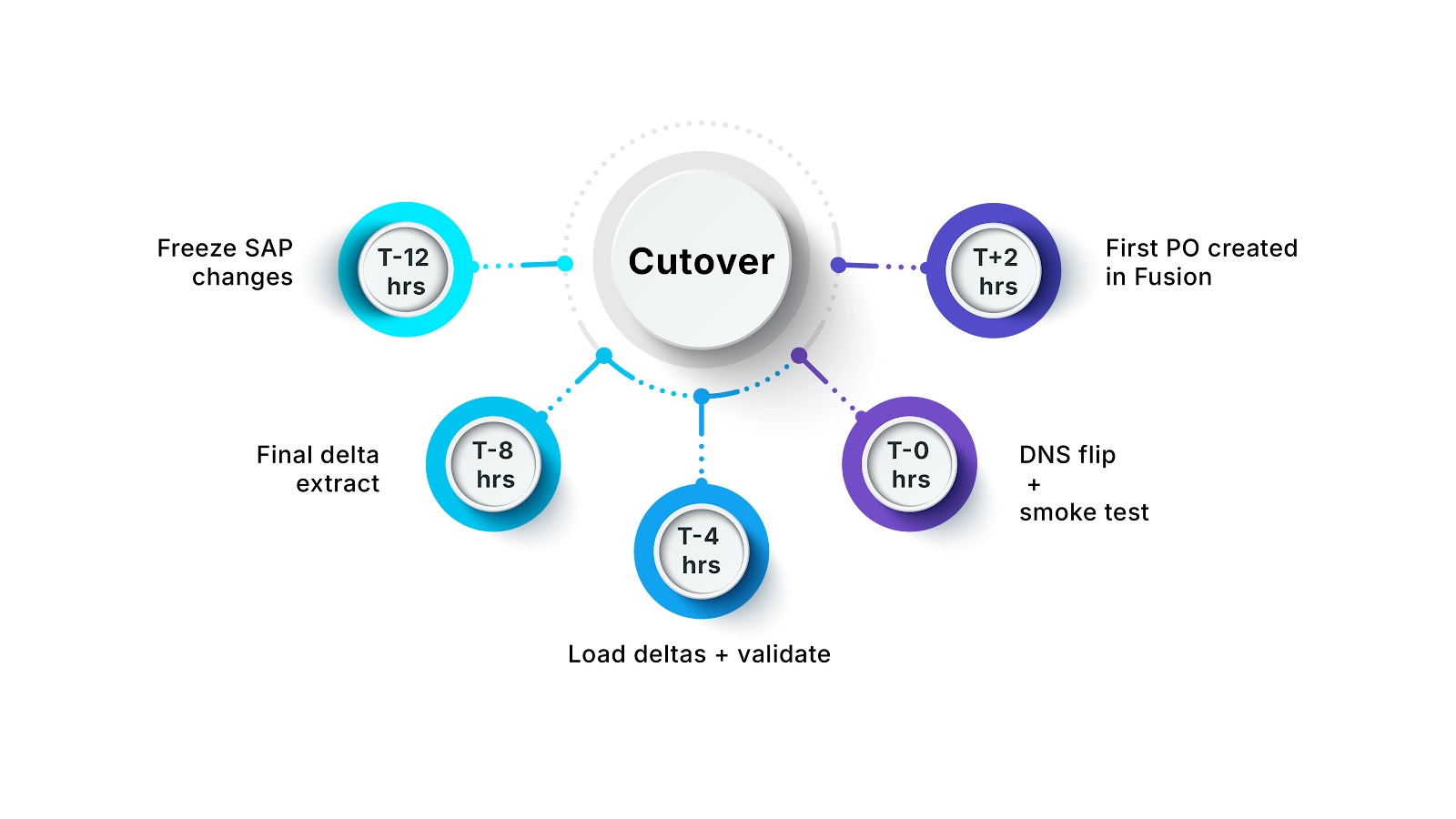
Actual downtime: 3 hours 42 minutes. Users logged in Monday morning to a system that looked familiar but ran circles around the old one.
Our managed services team shadows the client for 90 days. We monitor:
One client discovered 12% of AP clerks still printing invoices. We rolled out a 2-hour “Fusion in your pocket” mobile workshop—printing dropped to 0.3% in a month.
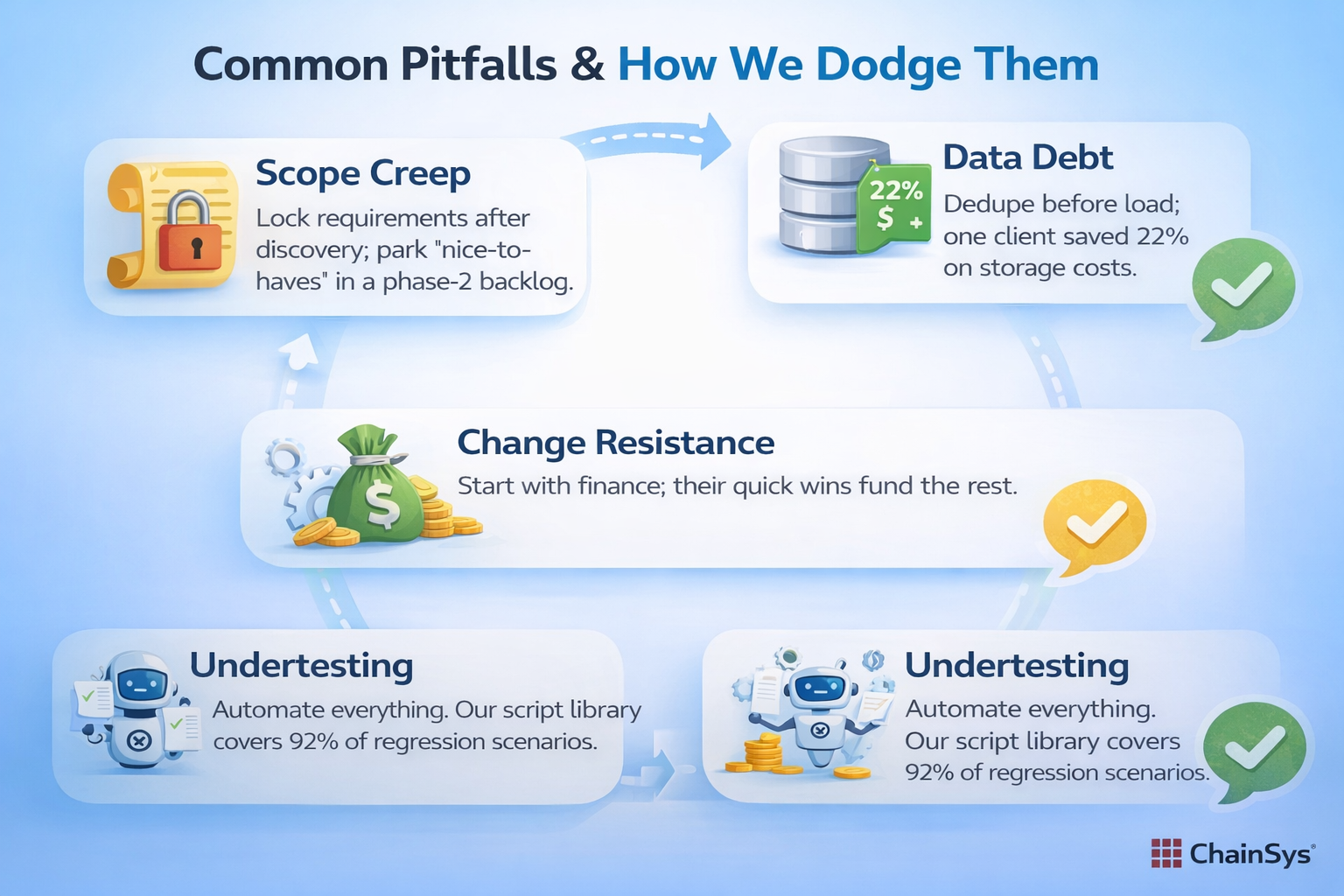
SAP R/3 to Oracle Fusion Cloud isn’t a project—it’s a transformation. Chainsys has done it for retail, manufacturing, life sciences, and energy. We bring the IP, the accelerators, and the battle scars.
You’ve kept SAP alive for 20 years. Now let it retire with dignity—and watch your business run like it’s 2030.